Wellness | Wellbeing | Health | Fitness
Introduction: Before Differences, There Was One Beginning
Human civilization has advanced enormously in science, technology, medicine, communication, and social development. Yet despite this progress, human beings still frequently divide themselves into rigid categories of superiority and inferiority based upon gender.
In reality, biology itself tells a far more beautiful story.
Long before society labels a child as “male” or “female,” every human life begins through a remarkably similar embryological journey. In the earliest weeks of development, the human embryo carries shared developmental pathways capable of differentiating into either male or female reproductive systems.
Nature first creates possibility.
Then biology guides specialization.
This shared developmental beginning is not merely an anatomical curiosity. It is a profound reminder that human beings are biologically far more connected than divided.
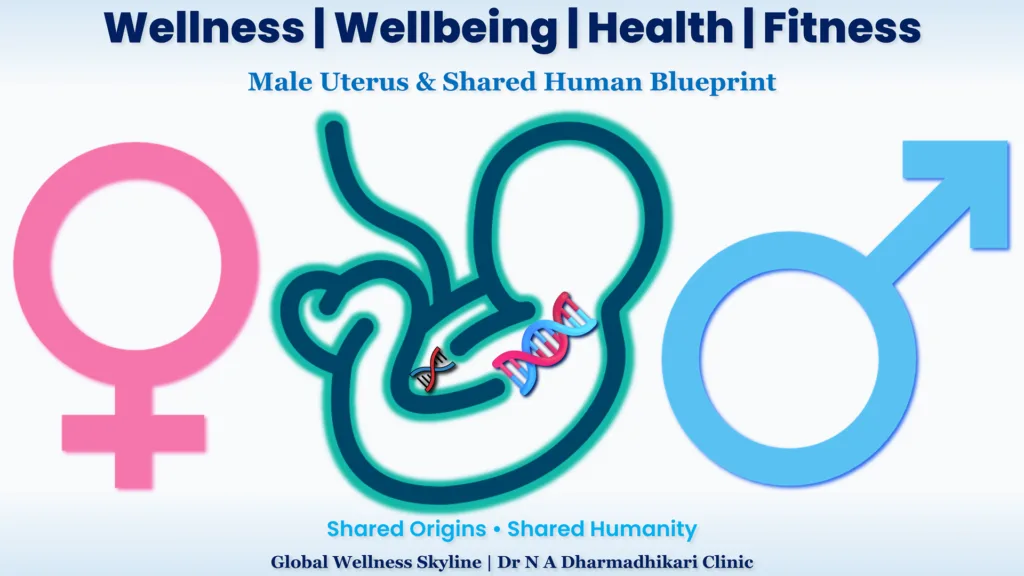
One of the most fascinating examples of this shared origin is the tiny structure within males called the prostatic utricle, historically referred to by some anatomists as the “male uterus” (uterus masculinus).
This article is not intended to create controversy.
It is not a political slogan.
It is not an attempt to erase biological differences.
It is an effort to help common people understand a simple but deeply meaningful scientific truth:
Human beings originate from a shared biological blueprint.
Perhaps understanding this truth can help society move toward greater dignity, respect, emotional maturity, and reduction of unnecessary gender discrimination.
International Women’s Day & Mother’s Day Beyond Symbolism
Why This Topic Matters in 2026
International Women’s Day 2026 carries the global theme:
“Rights. Justice. Action. For ALL Women and Girls.”
The campaign also emphasizes collaboration, support, and collective progress through the spirit of:
“Give to Gain.”
Similarly, International Mother’s Day reminds humanity to acknowledge the nurturing force behind human civilization.
However, respect for women and motherhood should never remain limited to one calendar date.
True respect should become a lifelong human attitude.
The purpose of this article is not only to discuss anatomy. It is also to encourage deeper understanding of:
- shared human biology,
- mutual dignity,
- emotional balance,
- healthy parenting,
- and respectful coexistence.
Because wellness is incomplete if society remains divided by ignorance, superiority, disrespect, or emotional imbalance.
One of the most astonishing facts in embryology is that early human embryos begin with remarkably similar developmental structures.
In the initial weeks of development, embryos possess:
- Müllerian ducts,
- Wolffian ducts,
- and bipotential reproductive tissues.
This means the embryo initially carries developmental possibilities for both male and female reproductive pathways.
In simple language:
Nature first prepares a common biological template.
Later, hormones and genes guide which pathway becomes dominant.
This does not mean males and females are identical.
It means they originate from a deeply connected developmental foundation.
The “6-Week Developmental Switch”
Around the early weeks of embryonic development, genes and hormones begin directing differentiation.
In embryos carrying the SRY gene on the Y chromosome:
- testes begin developing,
- testosterone production increases,
- Anti-Müllerian Hormone (AMH) suppresses much of the Müllerian system,
- and male reproductive structures gradually form.
In the absence of these male hormonal signals:
- Müllerian structures continue developing,
- eventually forming the uterus, fallopian tubes, and related female reproductive organs.
A very simple analogy is this:
Imagine a railway system with multiple possible tracks in the beginning. Gradually, signals direct the train toward one developmental route.
Nature does not build two completely unrelated human bodies.
Instead, it modifies a deeply interconnected biological framework.
What Is the “Male Uterus”?
Inside the male reproductive system exists a tiny vestigial structure called the prostatic utricle.
Historically, some anatomists referred to it as:
“Uterus masculinus” or “male uterus.”
Scientifically, this structure represents a small remnant of Müllerian developmental tissue.
It is important to understand clearly:
- it is NOT a functional uterus,
- it cannot carry pregnancy,
- and it is not equivalent to a female uterus.
Rather, it serves as a fascinating biological reminder of humanity’s shared embryological origins.
In a symbolic sense:
The male body quietly preserves a tiny developmental memory of our common beginning.
Human biology contains many examples of shared developmental origins.
Nature often modifies existing tissues instead of designing entirely unrelated structures from scratch.
Examples include:
| Male Structure | Female Counterpart |
| Testes | Ovaries |
| Penis | Clitoris |
| Scrotum | Labia |
| Prostate | Paraurethral (Skene’s) glands |
These are known as homologous structures.
This shared biological architecture demonstrates something profoundly important:
Biological diversity does not imply superiority or inferiority.
It simply reflects specialization of function.
Nature Creates Diversity — Not Hierarchy
One of the major misunderstandings in society is the belief that biological differences automatically imply unequal human value.
Science does not support such arrogance.
Biological systems evolve according to function, adaptation, survival, and reproductive roles.
Different functions do not mean unequal dignity.
The heart and brain perform different roles.
Yet both are essential.
Similarly:
- men and women may possess different biological specializations,
- but both carry equal human worth.
Biology creates diversity of function — not superiority of dignity.
This understanding forms one of the foundations of healthy civilization.
Perhaps the most beautiful expression of this shared human blueprint appears in parenting.
Society often rigidly labels emotions as:
- “motherly,”
- “fatherly,”
- “soft,”
- or “strict.”
But real life is often far more balanced and interconnected.
A father can express tenderness, patience, emotional warmth, and nurturing affection.
A mother can express discipline, firmness, accountability, and courageous protection.
Healthy parenting is not about rigid emotional compartments.
It is about balanced human qualities expressed according to the needs of the child.
A Personal Childhood Reflection
During childhood, I experienced something that I understood much more deeply only later in life.
Whenever I spent excessive time playing on the ground and neglected my homework, my father rarely reacted with immediate anger.
Instead, he would calmly explain:
“Play is important, but responsibilities are important too. Complete your homework sincerely first, and then enjoy your games freely.”
At that time, I saw it simply as parental advice.
Today, I recognize something deeper within it.
There was patience.
There was emotional understanding.
There was softness within guidance.
In many ways, my father carried motherly affection within his fatherhood.
On the other hand, my mother was an extremely gentle and compassionate lady. She mostly counselled with kindness.
But whenever she felt I was repeatedly avoiding responsibilities, she could become remarkably firm.
Sometimes beneath her signature on my school notebook, she would write:
“Please punish my son if he is wrong and not completing his homework sincerely.”
At that time, I feared such remarks.
Today, I understand their wisdom differently.
My mother carried fatherly discipline within her gentleness.
Those childhood experiences taught me something very important:
Human emotions are not strictly divided into “male” and “female” compartments.
Love can be protective.
Discipline can be compassionate.
And both parents together create the emotional security blanket every child deserves.
The Greatest Security Blanket for a Child
A child may forget expensive toys.
A child may outgrow material comforts.
But one thing deeply shapes emotional development forever:
Parents who respect each other.
The greatest security blanket a child can have is not wealth, status, luxury, or social prestige.
It is:
- mutual respect,
- emotional balance,
- dignity,
- cooperation,
- and healthy communication between parents.
Children silently observe how adults:
- speak,
- disagree,
- forgive,
- support,
- and cooperate.
From this environment, children gradually develop:
- confidence,
- emotional security,
- discipline,
- empathy,
- and self-respect.
Why Parents Sometimes Become Soft — and Sometimes Firm
Many children grow up misunderstanding their parents.
Sometimes parents appear extremely soft and affectionate.
At other times they appear strict, corrective, or demanding.
As children, we often interpret this inconsistency emotionally.
But maturity gradually reveals a deeper reality:
Most parents sincerely wish that their children grow into:
- responsible,
- disciplined,
- compassionate,
- capable,
- and emotionally stable human beings.
Affection without discipline may spoil a child.
Discipline without affection may emotionally wound a child.
Healthy parenting often requires balance between both.
This is why many cultures across the world regard parents with extraordinary reverence.
In the emotional world of a child, parents often function almost like living demigods:
- protectors,
- guides,
- teachers,
- and emotional anchors.
The shared embryological origins of males and females remind us of something psychologically meaningful:
Human qualities are not rigidly owned by one gender alone.
Compassion is not exclusively female.
Courage is not exclusively male.
Nurturing, discipline, sacrifice, emotional resilience, leadership, patience, protection, and responsibility can emerge within both men and women.
Roles may differ according to biology, culture, profession, family structure, or circumstances.
But human dignity remains fundamentally equal.
Role Flexibility During Life’s Challenges
Real life rarely follows rigid textbook definitions.
During illness, financial hardship, emotional crises, emergencies, or family struggles:
- fathers may become deeply nurturing caregivers,
- mothers may become pillars of strength and discipline,
- and both parents may exchange emotional or practical responsibilities according to necessity.
This flexibility is not weakness.
It is maturity.
Healthy families adapt.
Healthy relationships cooperate.
Healthy parenting evolves according to circumstances.
Scientific Understanding Can Reduce Gender Discrimination
Modern society often suffers from:
- comparison,
- superiority complexes,
- emotional polarization,
- and unnecessary conflict between genders.
However, embryology quietly teaches a different lesson.
Before differentiation:
human beings begin from remarkably shared developmental foundations.
Perhaps this scientific understanding can inspire:
- greater humility,
- reduced arrogance,
- emotional respect,
- healthier relationships,
- and more balanced parenting.
Equality does not require denial of biological differences.
True equality means:
recognizing equal human dignity despite differences in roles, functions, or physical characteristics.
Wellness Beyond the Physical Body
Modern wellness discussions frequently focus upon:
- diet,
- exercise,
- supplements,
- weight,
- and appearance.
But true wellness extends far beyond physical fitness.
Real wellness also includes:
- emotional maturity,
- social harmony,
- respectful relationships,
- responsible parenting,
- psychological balance,
- and intellectual humility.
A society cannot become truly healthy if it remains emotionally divided through disrespect, ego, discrimination, or superiority.
Understanding shared human biology may help humanity become not only scientifically informed — but emotionally wiser.
Perhaps one of the greatest lessons hidden within embryology is this:
Human beings are not created as enemies.
They are not created as biologically superior and inferior categories.
They are variations emerging from a deeply shared biological journey.
Nature begins with similarity before expressing diversity.
The male body carries traces of developmental pathways associated with female embryology.
The female body carries structures sharing developmental relationships with male anatomy.
These facts are not weaknesses.
They are reminders of interconnectedness.
International Mother’s Day & Women’s Day: Beyond Celebration
International Mother’s Day and International Women’s Day should not become merely symbolic social media occasions.
They should inspire:
- lifelong respect,
- emotional gratitude,
- healthier family environments,
- and greater social maturity.
Respect for women does not weaken men.
Respect for men does not weaken women.
Healthy civilization requires cooperation — not competition — between human beings.
The child benefits when:
- the mother respects the father,
- the father respects the mother,
- and both parents cooperate with emotional dignity.
That atmosphere becomes one of the most powerful foundations for mental wellness in future generations.
Important Scientific Clarification
This article simplifies embryological concepts for public understanding.
The term “male uterus” is historical and symbolic in educational discussion and should not be misunderstood as a functional uterus within males.
Similarly, emotional qualities like nurturing, discipline, affection, courage, or protection are complex human characteristics influenced by psychology, upbringing, culture, biology, experiences, and social environments.
The purpose of this article is not ideological conflict.
It is scientific reflection combined with wellness philosophy.
Perhaps the greatest mistake human beings make is forgetting how deeply connected they truly are.
Before identity,
before labels,
before social divisions,
there was a shared human beginning.
Embryology quietly preserves evidence of this truth within every human body.
Understanding our shared biological blueprint may not eliminate discrimination overnight.
But it can certainly encourage humanity to become:
- more respectful,
- more balanced,
- more emotionally intelligent,
- and more compassionate.
Biological differences create diversity of function — not inequality of human worth.
Human civilization progresses most beautifully when men and women respect each other not as competitors, but as complementary partners sharing a deeply connected biological and emotional origin.
And perhaps that itself is one of the highest forms of wellness.
“Motherhood, fatherhood, and parenthood are timeless responsibilities of love — not merely occasions for celebration.”
— Dr. Neelesh Aniruddha Dharmadhikari
Dr. Neelesh Aniruddha Dharmadhikari
Wellness | Wellbeing | Health | Fitness
For a healthier humanity through science, awareness, emotional balance, and respectful coexistence.
Published on: 10 May 2026
Occasion: International Mother’s Day 2026
<<Previous Article>>